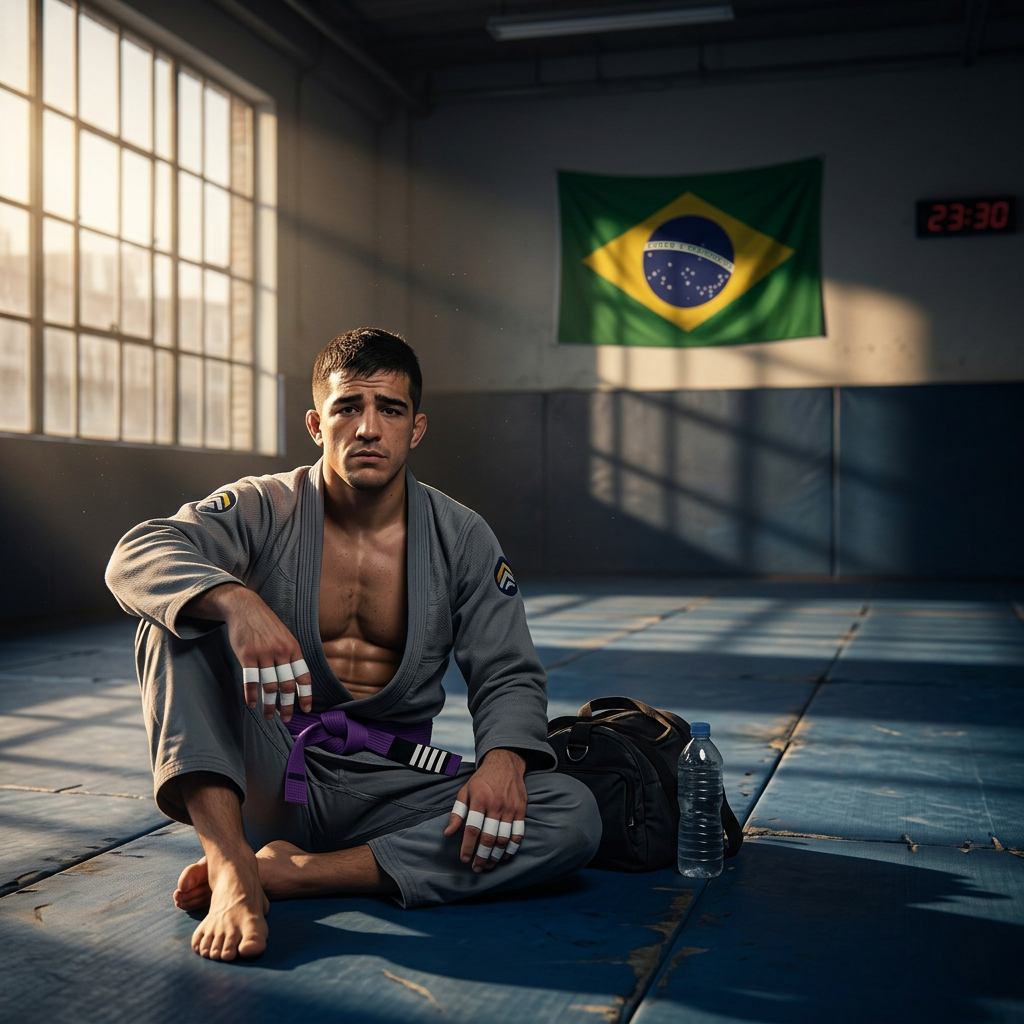
There comes a point in every serious grappler's journey where the training environment that made you stops being enough. You've been at the gym two, three, four years. You know how everyone moves. You know who shoots doubles on the first exchange, who turtles, who always stiff-arms. You're still getting reps in, but you're not getting better. You're just maintaining.
This happens fastest in smaller gyms and regional areas. It's not a knock on anyone — it's just math. A 50-person academy might have five or six people at a similar level to you. Once you've overtaken them on the mat, the gap keeps widening. Without pressure from above, your game stops evolving. You start filling time with movement rather than learning.
The good news: it's a solvable problem. Just not by waiting for the gym to grow around you.
The Trap Of Relative Dominance
Most grapplers in this position do one of two things. They either dial back intensity to keep training tolerable for their partners, or they start going through the motions — tapping people quickly and resetting, drilling the same sequences, never getting truly tested. Neither makes you better. Both feel comfortable enough to keep doing indefinitely.
Comfort at your home gym is the slow leak in your development. You don't notice it until you hit an open mat somewhere else or enter a bracket and realise your B-game has rusted out because nobody at home makes you use it. Positional dominance inside a single gym is misleading data. It tells you how you rank in one room, not how you actually move.
"Positional dominance inside a single gym is misleading data."
Chase Levels, Not Just Partners
The first fix is the most direct one: get to where the levels are. Open mats at larger academies, affiliate gyms with a deeper pool, regional competitions, seminars where you'll hit the mat with people you've never felt before. You don't need to leave your home gym. You just can't make it your whole world.
This means being honest about travel. If there's an open mat two hours away at a Checkmat affiliate or a regional IBJJF gym with a stacked adult division, that's worth the trip once or twice a month. One hard session with people who genuinely challenge you does more for your development than six comfortable weeks at home. You come back with new problems to solve. That's when growth actually happens.
Build A Game Nobody Can Solve
When you're the most experienced person in the room regularly, use that position deliberately. Instead of defaulting to your strongest positions, force yourself into the ones where you're weakest. Give up position to build recovery. Start from bad spots. If you've got a reliable armbar from mount, spend a month never finishing it — work the transition to back instead. Manufacture the difficulty your environment isn't providing.
This is also the time to go deep on the conceptual side of your game. Study. Watch footage with intent. Pick one position — say, turtle defence or the over-under pass — and spend a training block doing nothing else. When you can't be stretched by harder partners, stretch yourself by narrowing your focus aggressively. Depth in one area beats breadth across all of them when you're working without external pressure.
Privates Aren't Just For Beginners
This one gets overlooked. Private lessons are often seen as a tool for white belts trying to close gaps faster, but they're arguably more valuable the higher you go. At blue or purple, a coach can give you general corrections. At brown or black, the specific inefficiencies in your game are subtle — and a private with the right person surfaces them immediately.
You don't need to fly to São Paulo. There are black belts with deep technical knowledge all over the world who take privates remotely or during their own travel. A targeted session focused entirely on your specific problem — your defensive guard retention, your pressure passing, wherever you're losing — will give you six months of things to work on. If you're the biggest fish in your pond, the fastest way to grow is to get in a different pond temporarily and work with someone who can still see your holes clearly.
Teach More. You'll Learn More.
Being the most experienced person in your gym isn't only a limitation. It's a resource. Teaching forces you to articulate things you've been doing on instinct, and that articulation builds understanding in a way that drilling alone doesn't. When a newer student asks you why you frame with your elbow rather than your hand in a particular escape, you have to actually know the answer. Working through that — on the mat, with words — sharpens your own model of the technique.
This doesn't mean carrying the class. It means engaging seriously with the teaching opportunities you already have. Peer coaching, explaining details to training partners, running positional rounds with structure — these are all ways to extract more from a training environment that has less upward pressure than you need.
Stagnation in a small gym isn't inevitable. It's a logistics problem. Solve the logistics — travel, connection, deliberate practice — and your environment stops being a ceiling. OSS.
Questions or thoughts? Reach out: letsroll@newazanetwork.com